
The Five-Minute Conversation That Could Keep Your Athletes Healthy All Season
I had an athlete years ago who was one of the hardest workers I'd ever coached. Never missed a session. Never complained. You asked them to go, they went — every single time.
They got hurt three times in two seasons.
When I started looking at the pattern, it wasn't random. Every injury happened within two weeks of a stretch where they had been grinding through training that, looking back, their body was clearly telling them it wasn't ready for. They just never said anything. And I wasn't asking the right questions.
That experience changed how I approach monitoring.
The problem with "how are you feeling?"
Most coaches check in with their athletes. That's not the issue.
The issue is that "how are you feeling?" is a terrible question. It's too open-ended. Most athletes will say fine even when they aren't, because they don't want to look soft, they don't want to miss reps, they don't want to let their teammates down.
What you need is a structure. Specific questions with a defined scale that gives you real data, not a social answer.
I use a six-category daily wellness survey with every athlete I work with. Sleep quality. Stress. Soreness. Energy. Motivation. Mood. Each one scored on a 1–5 scale. Total out of 30.
Here's what those numbers tell you:
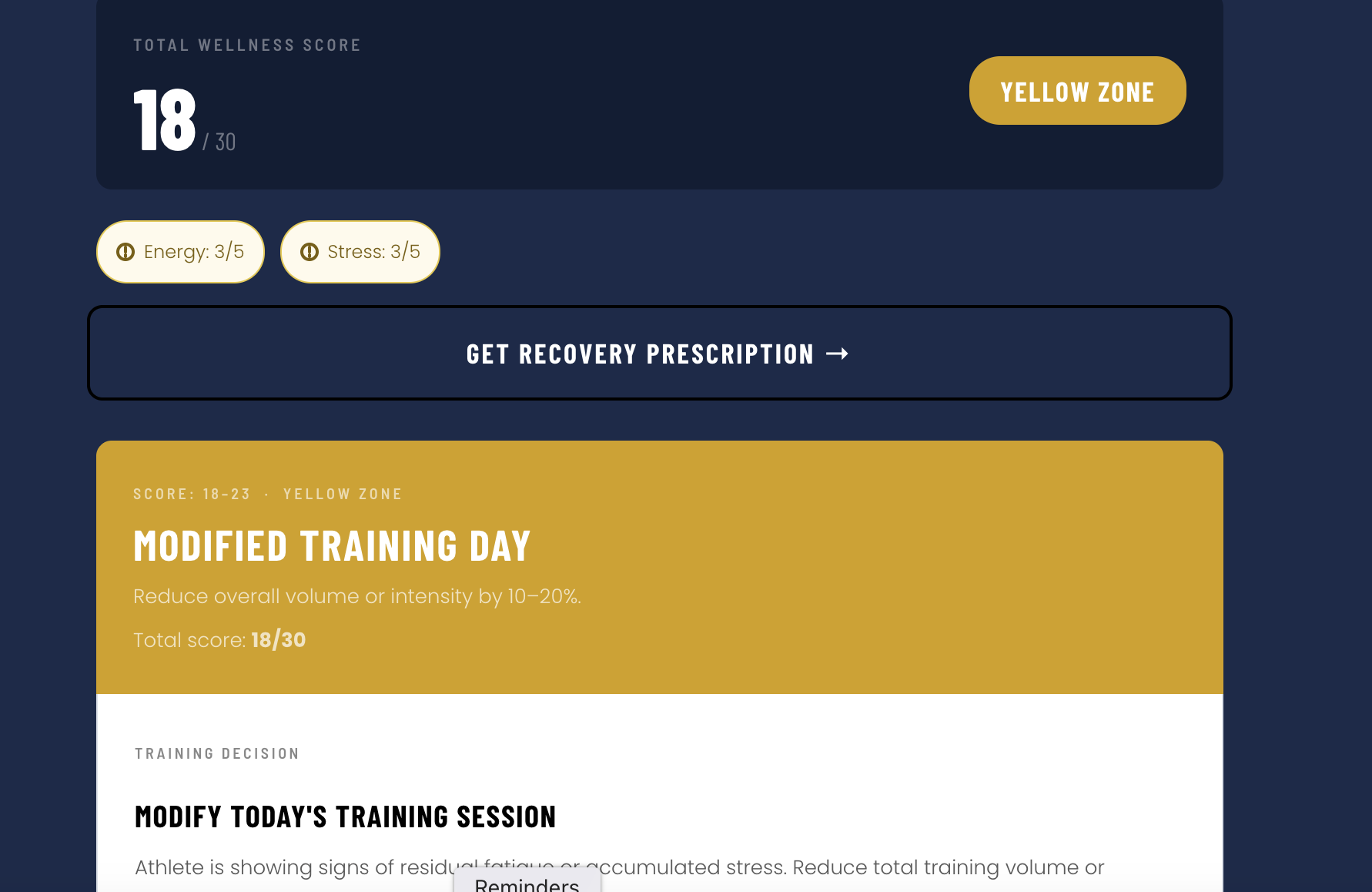
24–30: Green Zone. The athlete is recovered, ready, and able to handle the full planned training load. Execute the session as written.
18–23: Yellow Zone. There are signs of accumulated fatigue or stress. Reduce volume or intensity by 10–20%. Keep the primary stimulus of the session but pull back on secondary work. Watch how they respond in warm-up before committing to full intensity.
Under 18: Red Zone. This is not a training day. This is a recovery day. The question is only what kind of recovery — active methods, passive methods, or some combination based on where their energy and stress scores fell.
Simple? Yes. But the simplicity is the point. You don't need a GPS vest and a heart rate monitor to make a better training decision. You need six numbers and five minutes.
What the zones actually mean
A lot of coaches hear "red zone" and think it means the athlete is injured or sick. That's not what it means.
Red zone means the accumulated load — from training, from games, from life, from sleep debt, from stress — has exceeded what the athlete can currently handle and still adapt positively from another hard session.
Pushing through red zone doesn't make athletes tougher. It makes them more likely to get hurt.
The goal isn't to avoid hard work. The goal is to make sure hard work lands on a body that can absorb it and grow from it. If your athlete is red and you push them through a Day −4 session, you haven't won anything. You've just borrowed from next week.
The red zone athletes who run highest injury risk aren't the ones who score low on energy and stress together. Those athletes know they're tired — and so do you.
The dangerous ones are the athletes who score red on stress but still have high energy. High stress, high energy, low recovery — that's a nervous system that's running hot. You might not see it in their performance that day. You'll see it two weeks later when they pull a hamstring on a sprint they've done a hundred times.
That distinction matters. It changes the recovery prescription entirely.
The acute:chronic ratio — the number every coach should know
Daily wellness tells you where the athlete is today. The acute:chronic workload ratio tells you where they are relative to where they've been.
Acute load is the training stress from the current week. Chronic load is the rolling average over the past three to four weeks — the work the athlete has adapted to and can handle without unusual risk.
When the ratio of acute to chronic goes above 1.5, injury risk climbs significantly. When it dips below 0.8, the athlete is undertraining and losing the fitness adaptations they've built.
The sweet spot — roughly 0.8 to 1.3 — is where athletes get better and stay healthy.
This isn't a new concept. The research on this is well-established. Hulin, Gabbett, and others have written extensively on it, and what they found matches what I've seen over 25 years: the athletes who get hurt most often aren't the ones who train the hardest. They're the ones whose load spikes without adequate preparation or are under-recovered.
A sudden jump in training volume — a preseason ramp-up, a stretch of back-to-back games, a coach who decides to "load up" after an easy stretch — without the chronic base to support it is a recipe for the exact kind of soft tissue injury that ends seasons.
The fix isn't to train less. It's to train consistently enough that you've built a chronic base worth protecting, and then manage the acute load so it never gets too far above that base without a plan to bring it back down.
You don't need a sports science department to do this
I think there's a perception that this kind of monitoring is for professional programs with full performance staffs, wearable tech, and sports scientists on payroll.
It's not.
Six questions every morning. A total out of 30. A weekly load calculation based on session duration and RPE. That's it. A coach with 15 athletes can have every one of them fill out a form on their phone in the time it takes to get to the weight room, and have real data before the warm-up starts.
The question isn't whether you have the resources to monitor your athletes. The question is whether you have a system to do it with.
Because if you're making training decisions every day without that data, you're not making better decisions because you're experienced. You're making worse decisions because you're guessing.
What I actually do with the data
When an athlete walks in yellow, I don't panic and cancel the session. I adjust. Maybe we trim the volume by 15%. Maybe we extend the warm-up and see how they're moving before I commit to anything. Maybe the session goes ahead exactly as planned because their yellow score is driven by stress, not soreness, and the physical work is actually what they need.
When an athlete walks in red — especially two or three times in a row — that's a conversation. Something is off. Sleep, nutrition, life stress, academic pressure in college athletes. The training load is a variable I can control. The others I need to understand.
The wellness data doesn't make my decisions for me. It makes my decisions better.
That's all I'm asking for. Not perfection. Better.
Next week: The conditioning piece most coaches get backwards — why I train energy systems the way I do and how the Patel Training System connects conditioning to what actually happens in a game.
