
The Way You're Planning Your Game Week Is Probably Hurting Your Athletes

I want you to think about the last time one of your athletes got hurt during the season.
Not from contact. Not a freak play. A soft tissue injury — a hamstring, a hip flexor, a quad strain. Something that came out of nowhere on a Tuesday or Wednesday practice.
Now think about what that week looked like. What was the schedule? Where did the heavy training fall? How many days out from the previous game was it?
I'd bet that most of the time, if you map it out, the injury happened on a high-load day that was too close to either a game or another high-load day. Not because the athlete was unlucky. Because the week wasn't planned around them.
Most coaches think about weekly planning wrong
The default approach to structuring a practice week looks something like this: you have your game on Saturday, you have your practice slots Monday through Friday, and you fill them in based on what you want to work on that week.
Strength work goes when there's time for it.
Conditioning goes when the sport coaches ask for it.
Recovery happens when there's nothing else scheduled.
That's planning around the schedule. It's not planning around the athlete.
The approach that actually works starts from a completely different place.
You start at the game and work backwards.
Every day in a competitive week has a defined purpose relative to Game Day.
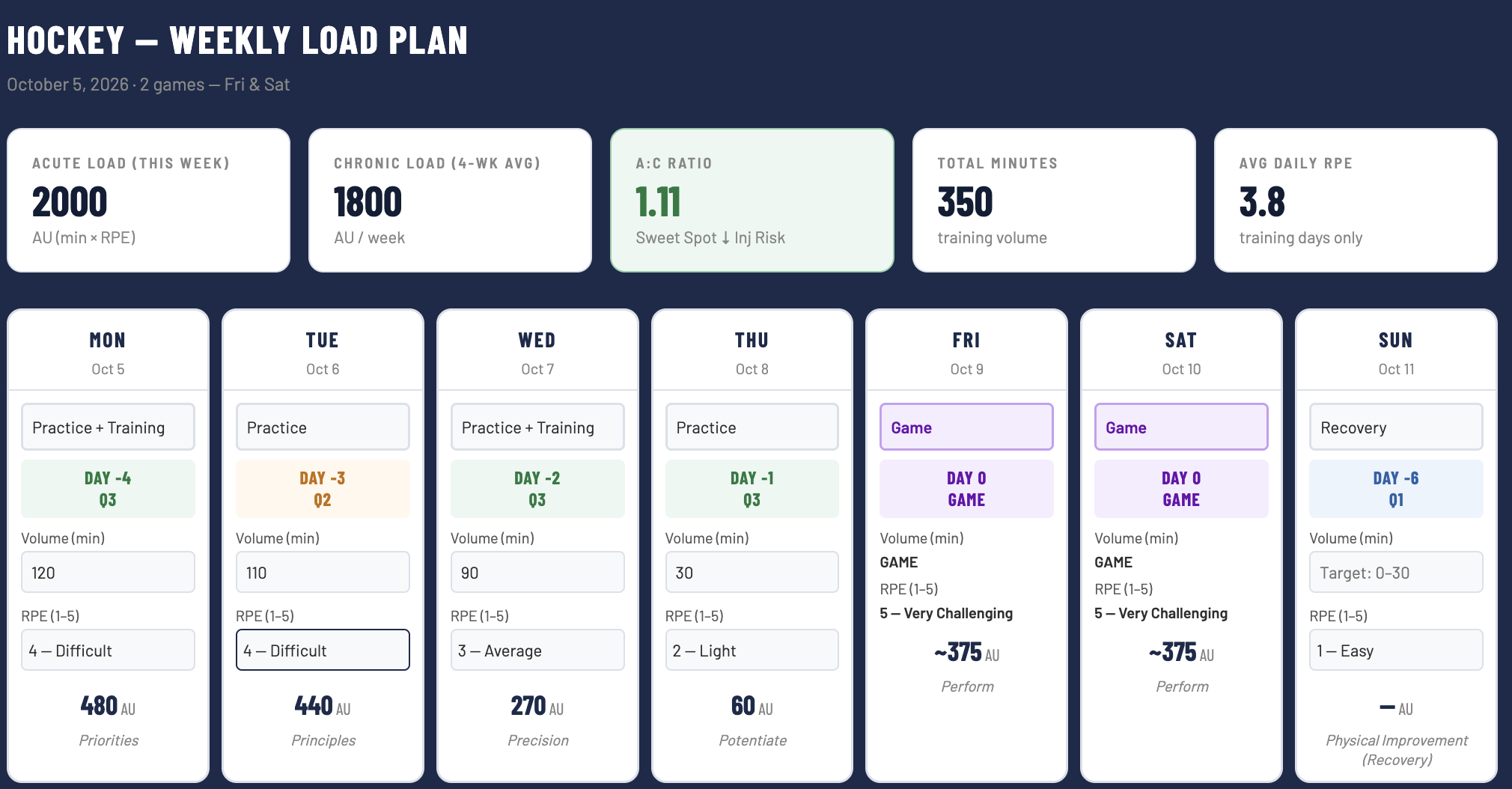
I call them day numbers — Day 0 is the game, and everything else is named by how many days before it falls. Day −1, Day −2, all the way back to Day −6, which is the day after the previous game and the first day of the new week's preparation cycle.
Each day number carries a different training prescription. Not just a different workout — a different theme, a different quadrant, a different volume target, a different intensity ceiling.
Day −4 is your hardest day. High volume, high intensity, strength development, eccentrics and isometrics. That's Priorities.
Day −3 steps back. Medium volume, alactic and aerobic development, large space tactical work. That's Principles.
Day −2 is lower volume, higher speed and power, game-like execution. That's Precision.
Day −1 is low volume, low contact, final rehearsal at game pace. That's Potentiate.
And Day −6 — the day after the game — is recovery. Light movements, reciprocal alternating patterns, replace fluids and energy. Nothing more.
When you understand this structure, it changes every decision you make about how to plan a week.

The problem I see most often
The most common mistake I see is putting high-load work too close to the game.
Day −1 is not the day for strength training.
Day −2 should not be your heaviest conditioning day.
I've also seen coaches pile high-load sessions back-to-back early in the week, thinking they're "getting work in" before the game. What they're actually doing is stacking fatigue without leaving enough time to recover before competition.
The acute:chronic workload ratio is real.
When your weekly training load spikes significantly above your athlete's chronic baseline — the work they've adapted to over time — injury risk goes up.
Not maybe.
It goes up.
The research is clear on this and my own experience over 25 years confirms it.
You cannot out-tough a week that's planned wrong.
The athlete who pushes through Day −2 heavy conditioning isn't being mentally tough. They're accumulating fatigue that will either hurt their performance on Saturday or hurt their body sometime in the next three weeks.
Two-game weeks make this even more critical
Single-game weeks give you enough runway to manage the load. Two-game weeks, where you might have a Thursday game and a Saturday game, or Friday and Saturday back-to-back — those require a different framework entirely.
With two games, you're not just planning backwards from one Day 0.
You have two Day 0s.
That means the days between them aren't preparation days in the traditional sense — they're bridging days.
Low volume, low intensity, focus on recovery and activation.
A lot of coaches try to squeeze training into the gap between games.
I understand the instinct.
But compressing high-intensity work into a day-between game situation is one of the fastest ways to accumulate the kind of fatigue that turns a hamstring into a two-week absence.
The decision about how to structure those days should be informed by data — how did the athlete respond to the first game? What does their wellness score look like that morning? Are they green, yellow, or red?
That's not guesswork. That's a system.
What this looks like in practice
When I sit down to plan a week, the first thing I put on the calendar isn't the workout. It's the game. Then I count backwards and assign the day numbers. Then I look at what the template says each day should look like — the theme, the quadrant, the volume range, the RPE target.
Then I adjust based on what the athletes are actually showing me.
Their wellness data from that morning.
Their movement quality in warm-up.
Their performance in the previous game.
The template is the starting point. The athlete's response to training is what tells me whether to stay on plan or modify.
That combination — a structured framework plus real-time monitoring — is what separates load management from just having a schedule.
The question every coach should ask
Before you finalize your plan for next week, map out your training load by day number. Look at where your heaviest sessions fall relative to the game. Look at whether Day −1 actually looks like a Day −1 should.
If it doesn't, that's where you start.
The athletes who stay healthy across a full season aren't just lucky. They have coaches who plan their weeks the right way.
Next week: Why daily wellness monitoring isn't a luxury for professional teams — it's the most important five-minute conversation you can have with your athletes before practice.
