
Why Your Conditioning Isn't Working (And How to Fix It in Three Questions)

I get asked about conditioning more than almost anything else.
And when I dig into what coaches are actually doing, the problem is almost always the same.
It's not that they're lazy.
It's not that they don't care.
It's that they're training the wrong system — or the right system the wrong way — because nobody ever taught them how to think about energy system development as a prescription.
Not a workout. A prescription.
There's a difference. A workout is a collection of exercises. A prescription is the right method, for the right system, at the right time, with the right parameters — chosen based on what the athlete actually needs.
That difference is what separates conditioning that builds athletes from conditioning that just makes them tired.
Three systems. Three jobs. One framework.
Every coach knows the three energy systems. Phosphocreatine (alactic), glycolytic (lactic), aerobic (oxidative). You learned this in exercise science. You can probably recite the work-to-rest ratios.
But here's where most coaches get stuck: knowing the systems exist is not the same as knowing how to train them — or more importantly, which one to train, and when.
Each system has a specific job in athletic performance.
The alactic system is your explosive engine. Short, maximal bursts — 2 to 10 seconds. A basketball cut. A hockey shift start. A football play. The phosphocreatine system doesn't care how fit you are. It cares how much power you can produce right now, at maximum intensity, before it runs out of fuel. When it depletes, you need time and oxygen to recharge it. Which brings us to the second system.
The aerobic system is your recovery engine. Its job during competition isn't just to sustain long efforts — it's to replenish the alactic system between explosive bouts. The stronger your aerobic base, the faster your phosphocreatine recharges on the bench, between plays, during the walk back. This is why a hockey player with a weak aerobic base fades in the third period even though hockey is a sprint sport. The sprints aren't the problem. The recovery between sprints is.
The lactic system bridges the two. It handles sustained high-intensity efforts — the 20 to 90 second window where neither alactic nor pure aerobic can carry the load alone. It's the most uncomfortable system to train because it generates lactate and forces the athlete to work through real fatigue. That's also why coaches either overuse it (because it looks like hard work) or underuse it (because athletes hate it). Neither extreme is right.
The question isn't which system is most important.
They're all important.
The question is which one to target, in which proportion, at what point in the year.
The mistake I see most often
Walk into most gyms during the off-season and you'll find athletes doing one of two things for conditioning: long slow cardio or all-out sprint intervals with short rest.
Both have their place. Neither one, used exclusively, prepares an athlete for what a game actually demands.
Long slow cardio builds the aerobic base. But if that's all you do, your athletes are aerobically fit and alactically underprepared. They can run a timed mile but they can't produce repeated explosive sprints at game speed.
Short rest sprint intervals feel brutal. They produce visible fitness. But they're primarily training the lactic system — the glycolytic pathway — not the alactic system they're supposed to mimic. The key is that lactic work requires incomplete rest. Most coaches are giving their athletes too little rest on sprint sessions and calling it alactic training. It's not. If your athletes are sprinting every 30 seconds, you're not training their max power output. You're training their lactate tolerance. That's a real quality — but it's a different adaptation than the one you think you're getting.
True alactic training requires 2 to 5 minutes of full rest between reps. Heart rate back to 120 or below before the next effort. The athlete has to feel recovered before they go again — because the goal is maximum power output on every single rep. The moment they're running on a partial tank, the adaptation shifts.
I know that doesn't look like hard work from the sideline. Coaches get uncomfortable when their athletes are standing around catching their breath for three minutes. But that rest is the training. Shortening it doesn't make it better. It makes it different — and different isn't what your athletes need at that moment.

Phase matters as much as method
Here's the other variable that most programs ignore: the same energy system method that's ideal in October is wrong in January and counterproductive in March.
Post-season, your athletes are beat up. The aerobic system is the priority — Cardiac Output, Tempo Runs, the Oxidative Method. Low intensity, high volume, no lactic stress. The goal is to restore the parasympathetic system, rebuild the aerobic base, and develop mitochondrial density while the body heals. This is also when the Oxidative Method — compound strength movements at 30 to 40 percent intensity, constant breathing, no lockout — does something most coaches aren't doing: it trains the aerobic system through resistance training. No running required.
Off-season is where you load all three systems. Build the aerobic base first, then introduce alactic power, then layer in lactic capacity. Not all at once. In sequence. Each phase building on the one before it.
Pre-season shifts the priority again. You're not building fitness anymore — you're converting it to sport-specific readiness. Shorter sessions, higher intensity, work-to-rest ratios that mirror game demands. The conditioning becomes more specific. The volumes come down.
In-season, you're not building anything. You're managing load and maintaining the qualities you've developed. The game provides the lactic and alactic stimulus. Your job is to keep the aerobic base intact and make sure the weekly load doesn't exceed what the athlete can recover from before the next game.
If you're doing the same conditioning in February that you did in October, you're not periodizing your energy system development. You're just exercising.
Why I built the Energy System Prescription Tool
I've had this framework in my head — and in my notes, and eventually in the Patel Training System — for 25 years. The problem is that applying it in real time isn't simple. You need to know the sport, the phase of the season, the training goal, and then cross-reference all three against the right method — with the right parameters, the right protocols, and the right alternatives if the primary method doesn't fit.
Doing that manually, every week, for multiple teams, takes time most coaches don't have.
So I built a tool that does it for you. You can try it free right now at Energy System Tool — no membership required.
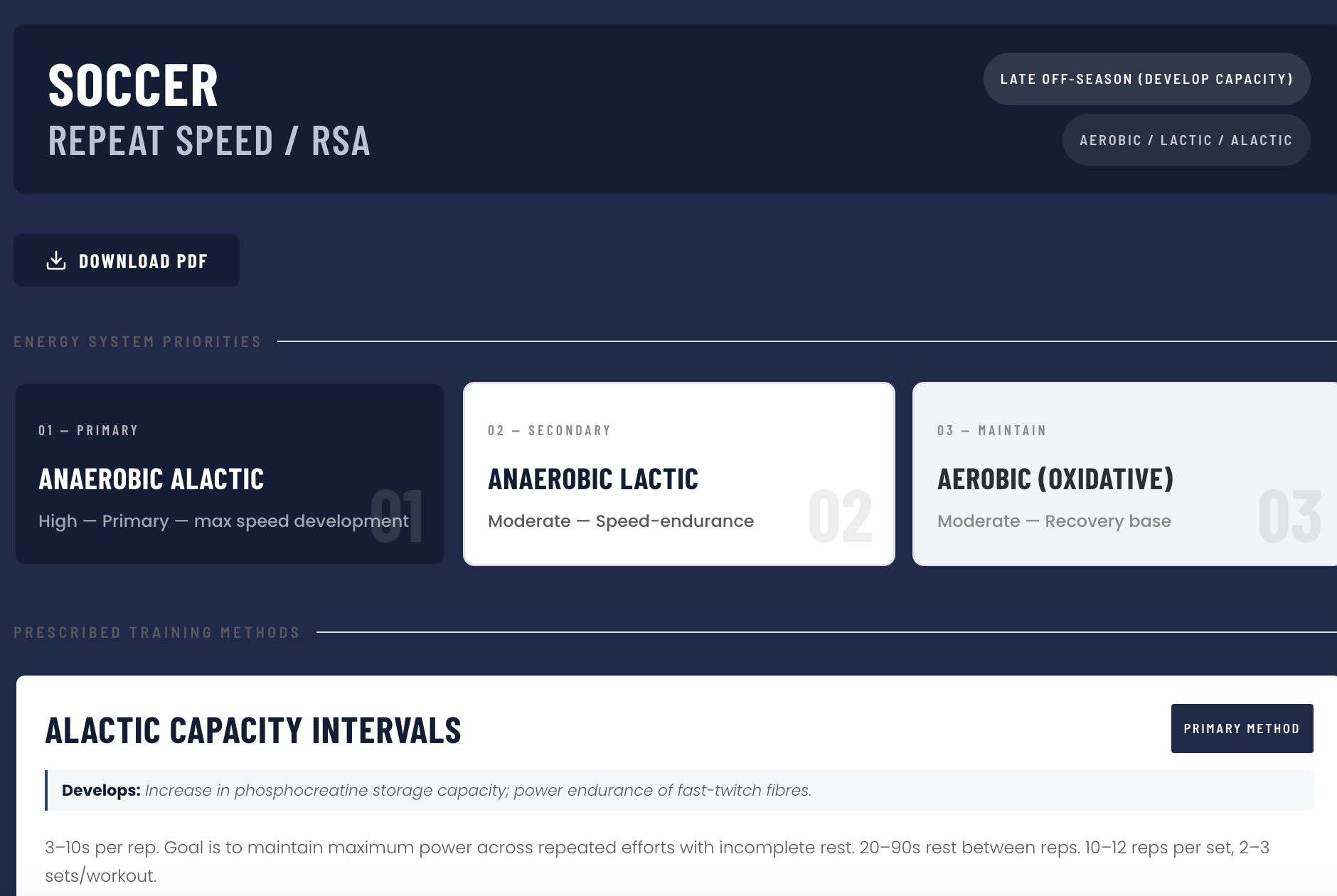
You select the sport. You select the phase of the season. You select the training goal. The tool pulls the prescription — the primary method, the energy system priorities, the protocol options, the coaching notes, and the volume guidelines — in about three seconds.
It covers 13 sports across five phases of the year — post-season, early off-season, late off-season, pre-season, and in-season. Each combination produces a different prescription because the right answer is actually different. A basketball player in post-season working on aerobic base gets a completely different protocol from a hockey player in pre-season working on alactic power. Both get exactly what they need based on their sport's energy demands and where they are in the year.
The alternatives matter too. The primary method is what I'd choose first. But sometimes you don't have a track. Sometimes your athletes can't run due to an injury. Sometimes you need a bike-based option or a strength-based option. The tool shows you those alongside the primary with full detail on each — duration, intensity, rest, frequency, and specific protocol options to run with.
What it doesn't do is guess. Every prescription in there is built from the same system I've been using with Division I athletes since 2001. You're not getting a generalized recommendation. You're getting a method, with rationale, connected to specific physiological targets, that you can run with tomorrow. You can learn more about the full tool and how it was built at coachbpatel.com/esd
The practical takeaway
If nothing else, take these three questions into your next conditioning session:
1. Which energy system am I actually targeting right now? Not which one you mean to target — which one does the actual work-to-rest ratio train?
2. Does this match where we are in the season? Post-season aerobic work, in-season maintenance, and pre-season conversion are three completely different things. Is what you're doing appropriate for where your team is?
3. Are the parameters right for the adaptation? Alactic training requires full recovery. Lactic training requires incomplete recovery. Aerobic training requires sustained work at the right heart rate. If the parameters are off, the adaptation is off — even if the exercise is right.
Those three questions are the filter. Run every conditioning session through them.
The more often you do, the less often you'll have athletes who are "fit" but can't perform in the 3rd period or second half.
The free version of the Energy System Prescription Tool is at Free ESD Tool— try it with your current sport and phase and see what comes back. The full tool, including the complete method library, all sport profiles, expanded coaching notes, and the rest of the Patel Training System tools, is available through the Pro and Elite membership tiers: Coach B Memberships. More on the tool itself at Energy Systems
